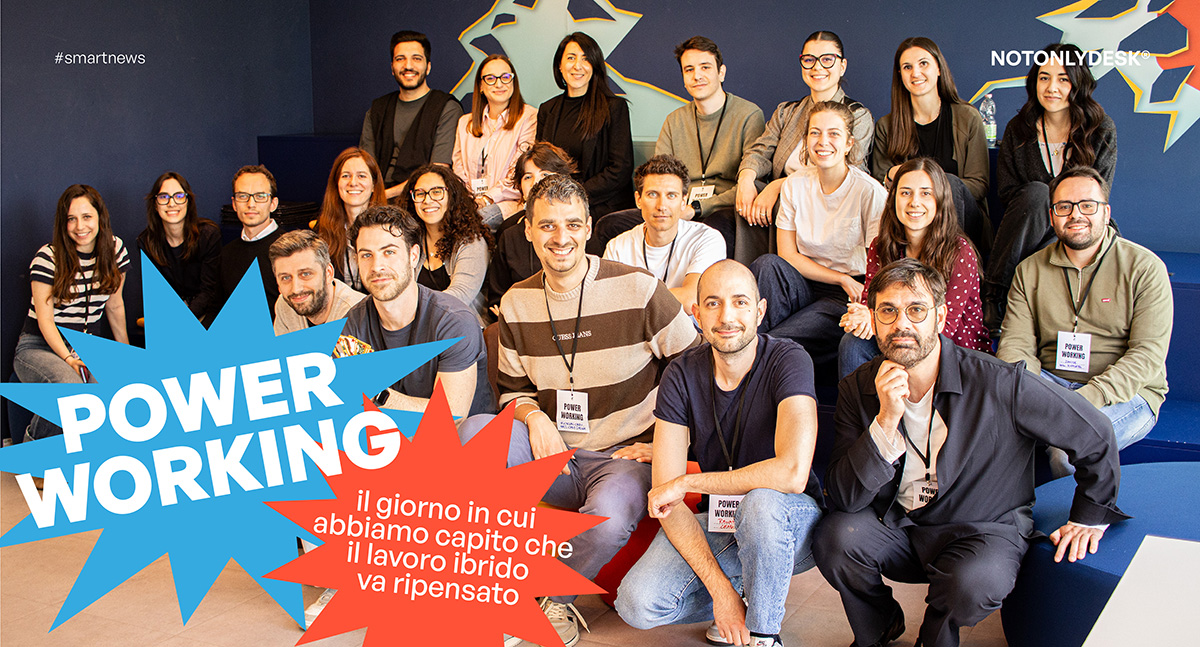
The day we realized hybrid work needs to be rethought
On April 15, at the Randstad Box in Milan, we had to admit that hybrid work isn’t working. We didn’t expect to reach this conclusion, but we prefer to be honest.
Throughout the day, between breakfast and an aperitivo, we listened to companies, HR professionals, and workers who experience this model every day. And the point became clear right away, without much hesitation: something isn’t working.
Why isn’t hybrid work working?
In recent years, we’ve given a name to something that still doesn’t have a clear shape: what is hybrid work? Every organization is building its own balance—some define a minimum number of in-office days, some work entirely by objectives, some allow total freedom, while others are moving back toward more rigid models.
None of these models is truly established. In large Italian companies, people work remotely on average between 6 and 9 days per month, with policies that evolve over time and adapt to teams. At the same time, over 70% of people consider this flexibility a given, no longer negotiable.
- On one side, companies are trying to bring people back to the office by introducing rules, incentives, or programs to increase presence. On the other, people are asking for autonomy, flexibility, and freedom of choice. - Many workplaces today are underused or even empty. According to data, around 55% of spaces are underutilized. The root of the problem—the design of work itself—is rarely addressed. - In many contexts, people still go to the office, but not always out of real operational need. Instead, it’s often for visibility, to avoid implicit penalties, or to align with a culture that has not yet evolved. - If there’s one point of strong agreement—both in the data and among participants—it’s the need for autonomy. Around 70% of younger generations prefer having the freedom to choose where they work.
The great paradox of smart working
About 43% of smart workers work from home without an adequate setup, impacting concentration, posture, and the quality of interactions. What’s missing is an intermediate infrastructure between home and office—one that ensures quality, flexibility, and proximity.
But here’s the key point: both the data and direct conversations with those experiencing this daily show that this isn’t a failure, but a transition phase. Today, many organizations are:
- testing different models - adapting policies in the short term - reacting rather than designing
What’s truly missing is a structured long-term vision.
The point is not choosing between office and remote work. The point is building a system that integrates flexibility, spaces, autonomy, and culture.
And it’s precisely through real-world experiences—like those shared during the event—that it becomes clear: as long as these elements remain disconnected, hybrid work will continue to feel like a problem.
Our role in this scenario
At NOTONLYDESK, we work every day to support companies and professionals in building more flexible, accessible, and sustainable ways of working.
Working closely with organizations allows us to bring real ideas, models, and solutions that address concrete needs. If your company is facing these challenges, this is the right time to start rethinking them in a more structured way.
Let’s talk
If you want to understand how to evolve your work models, spaces, and organization more effectively, connecting with those already working on these topics can make the difference.
👉 Get in touch with us to explore needs and solutions for your team.
Coworking and workspaces starting from €22 per dayWith NOTONLYDESK you can book coworking spaces, workstations, private offices, and meeting rooms throughout Italy, with solutions starting from €22 + VAT per day and with no city-specific surcharges.
= 1 NODEY =
1 DESK WORKSTATION for the entire day, per employee1 MEETING ROOM for 1 hour, per employee