Attendance and space utilization: the difference that impacts your budget
November is here, bringing with it one of the year’s biggest challenges: deciding how to invest your company’s resources in 2027. Perhaps you’re considering renewing a lease, introducing a new hybrid working policy, or reviewing employee benefits. And you’re probably facing a familiar problem: figuring out which investments will deliver value and which will end up weighing on your budget.
Take offices, for example. You know how many people come into your workplace each week, but do you also know how much the spaces you pay for are actually being used? It’s a crucial distinction: someone may come into the office and spend most of the day in meetings, leaving their desk unused. Yet when it’s time to renew a lease, attendance figures are often the starting point.
Hybrid working is stable. Business decisions, less so.
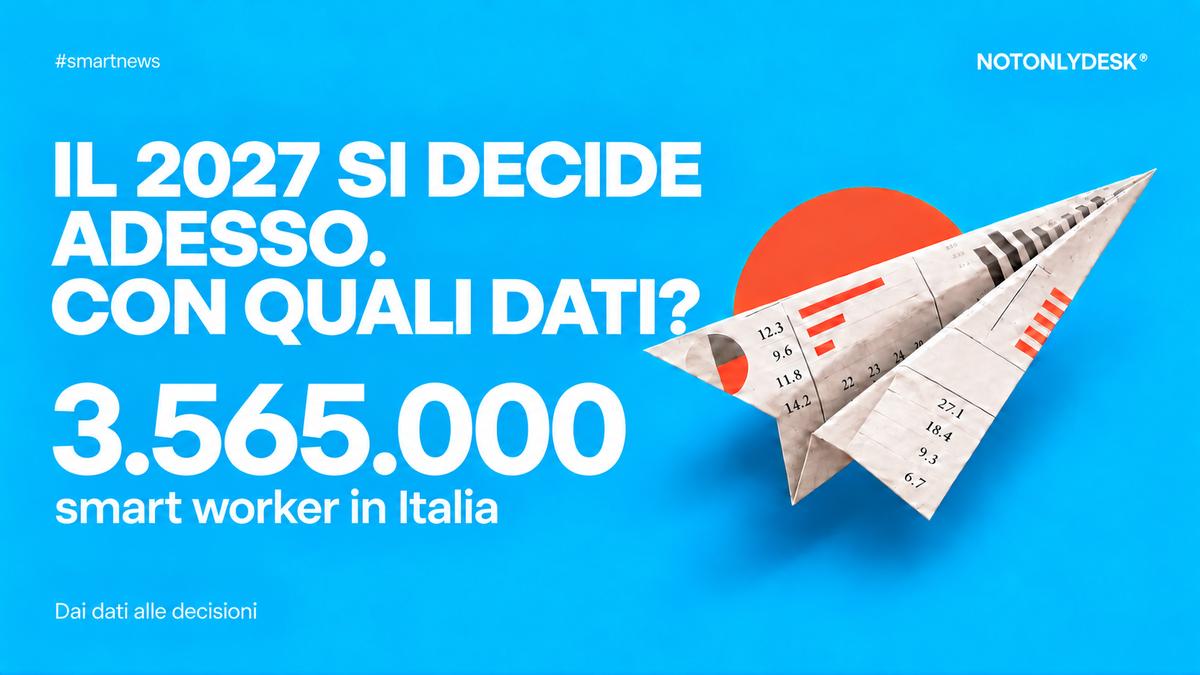
Let’s start with a shift you’re already familiar with. According to Politecnico di Milano’s 2026 Smart Working Observatory, Italy has 3,565,000 hybrid workers, a figure that has remained largely stable for four years. This means millions of people alternate between locations and ways of working, while offices continue to account for a significant share of business costs.
Yet 19% of large companies still don’t know how their policy will change in 2027. That’s understandable: changing attendance requirements affects people’s routines and how work is organised. So, before deciding how many days employees should spend in the office, it’s worth asking what happens during those days. If people come in to collaborate, they’ll probably need different spaces from those doing individual work.
This becomes even more relevant when you consider that only 36% of large companies allow employees to work from coworking or other third-party spaces, an option offered by just 3% of SMEs. Yet having access to a professional workspace close to home or within easy reach could make it easier to organise the working day, while reserving the main office for activities that particularly benefit from meeting in person.
To explore this, we need to distinguish between two workplace management concepts: occupancy and utilization. The first describes how occupied spaces are, while the second looks more closely at how they are actually used.
Imagine every desk is occupied on Tuesdays, while the office is almost empty on Fridays. The weekly average might suggest you should reduce your office space, but that decision could cause problems on your busiest days. If, on the other hand, meeting rooms are constantly booked while many desks remain empty, you may need to rethink how the space is allocated.
Companies are already responding to this shift: 66% of large companies have introduced desk and workspace booking systems, while 59% have reduced or reorganised their office space. These tools can provide valuable insights, especially when bookings are compared with actual usage.
Five data points to bring to your next meeting
Now that we’ve established why attendance only tells part of the story, we can identify the information you need to make decisions.
Start with space usage across the days of the week to understand when demand rises and falls. Compare this with the cost per desk actually used: you’ll see how the space you pay for measures up against its actual use. Look at weekly peaks too, as these can put pressure on an office sized solely around average attendance.
Next, compare demand for meeting rooms with demand for desks. You may find that your team needs more collaborative spaces and fewer permanent individual workstations. Finally, consider employees’ commuting distances, because a workspace close to home could be more useful than an available desk at the main office.
Once you’ve identified these needs, you can consider how to organise your spaces without necessarily choosing between keeping all your current offices and drastically reducing them. One option is to complement your company office with a network of professional workspaces available on demand, especially when employees work from different cities or have occasional workspace needs.
With over 235 operational locations across every Italian region, NOTONLYDESK enables companies to offer employees professional workstations, private offices, meeting rooms, and spaces for training, workshops and events.
NOTONLYDESK, NOD, gives you a single dashboard to manage coworking spaces throughout Italy, using Nodey (digital tokens) to book desks, meeting rooms or private offices.
Discover how NOD works and start a trial for your team.
Coworking and workspaces starting from €22 per dayWith NOTONLYDESK you can book coworking spaces, workstations, private offices, and meeting rooms throughout Italy, with solutions starting from €22 + VAT per day and with no city-specific surcharges.
= 1 NODEY =
A desk for the full day, starting from €22, or 1 NODEY per employee with a business package.A meeting room for 1 hour.